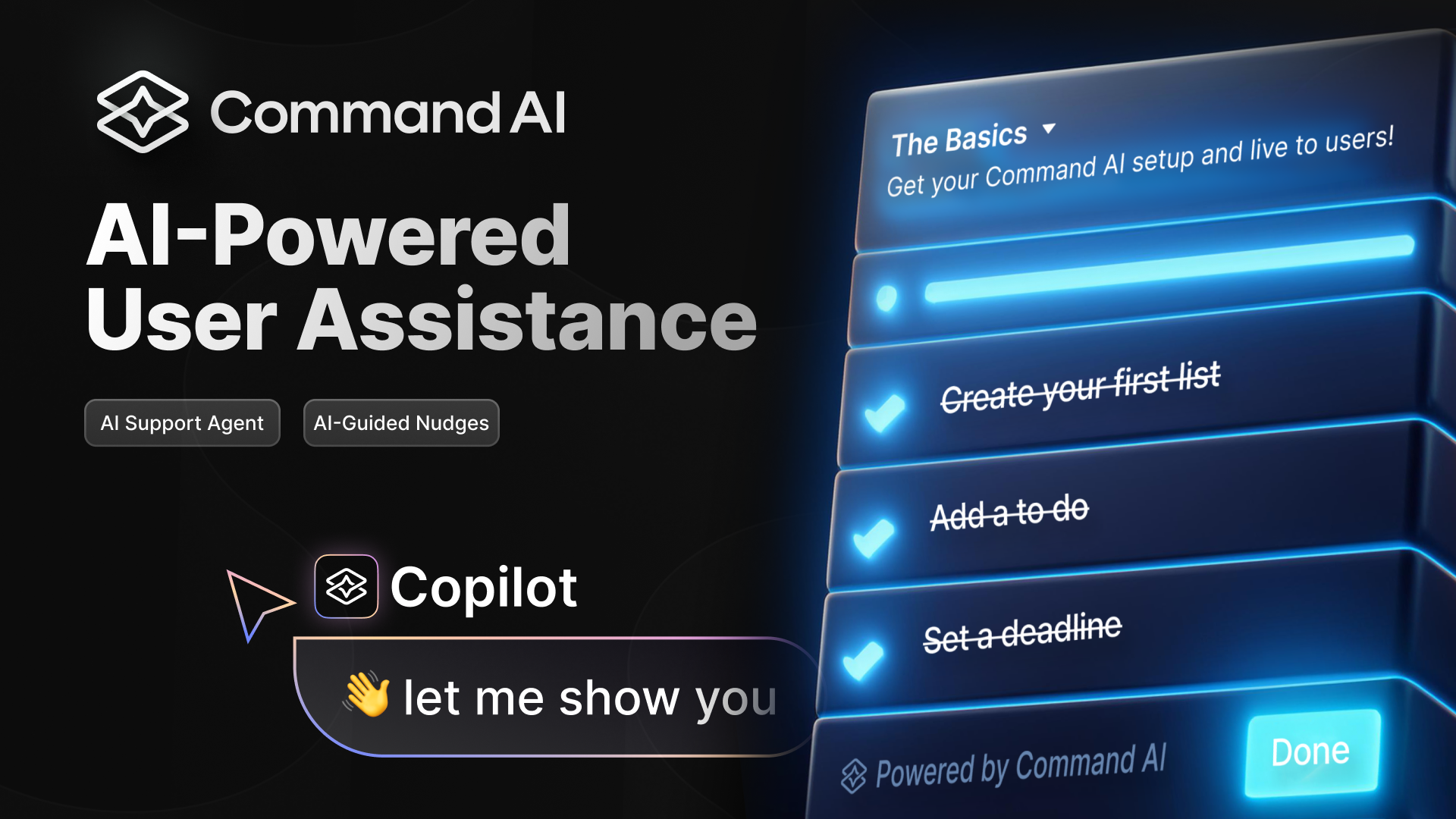
Command AI
Command AI is a tool that enhances productivity by automating repetitive tasks, streamlining workflows, and enabling teams to focus on strategic initiatives and decision-making.
Command AI is an AI-powered user assistance platform that embeds directly into software products to help users discover features, locate information, and execute autonomous actions through natural language commands, driving higher engagement and activation.[4][5] Its core value proposition lies in transforming complex products into intuitive experiences by providing real-time guidance and task automation, reducing user friction and boosting productivity without requiring extensive training.[5]
Key features include intelligent conversation for queries, content generation on demand, proactive search across the product interface, and the ability to perform directed actions like updates or navigations seamlessly.[4][5] Ideal for product teams, SaaS companies, and developers building customer-facing applications, it supports use cases such as onboarding new users, enhancing support in enterprise tools, and optimizing self-service workflows.[5]
What sets Command AI apart is its in-product native integration, which outperforms standalone chatbots by leveraging contextual product data for precise, autonomous assistance, resulting in superior user retention and satisfaction as evidenced by its high ratings.[5]
The ToS permits Company to use deidentified data derived from Customer Content for service improvement and development p
No training opt-out mechanism was identified in the legal documents.
Moderate risk. Suitable for internal data but avoid confidential information.
The ToS permits Company to use deidentified data derived from Customer Content for service improvement and development purposes, but lacks explicit clarity on whether raw user data trains the AI model. The Privacy Policy mentions analyzing usage for R&D but does not explicitly state whether End User Content feeds the training pipeline.
“[ToS] "Company has the right to collect, use and analyze any deidentified information derived from the Customer Content, including End User Content...for Company's lawful business purposes, including to improve and enhance the Services"”
Customer grants Company a non-exclusive license to use Customer Content for service provision, but the scope is somewhat broad. Company also claims rights to use Feedback in perpetuity and irrevocably, and can use deidentified data without clear limitations on derivative works or sublicensing.
“[ToS] "Customer grants to Company...a non-exclusive license to use the Customer Content as necessary for purposes of providing the Services" and "Company...a worldwide, non-exclusive, irrevocable, perpetual, royalty-free right and license to incorporate the Feedback into Company products and services"”
Privacy Policy indicates sharing with service providers, affiliates, and business partners, but lacks detailed sub-processor list or explicit DPA requirements. Sharing with business partners for their own purposes is permitted, and deidentified data sharing is broadly allowed.
“[Privacy] "We may share your personal information with...Service providers...Business partners...These business partners may use the information we share with them for their own purposes" and "We may share...anonymous, aggregated or de-identified data...with third parties for our lawful business purposes"”
ToS provides 30-day return window for Customer Content after termination, but retention periods during active use are not clearly specified. Privacy Policy lacks explicit data lifecycle documentation or automatic purge timelines.
“[ToS] "Within thirty (30) days following termination of this Agreement for any reason, Company, upon Customer's written request, will return all Customer Content to Customer...Thereafter, Company reserves the right to permanently and definitively delete the Customer Content"”
ToS explicitly states Customer retains all right, title and interest in Customer Content except for the limited license granted to Company. Company makes no claim to ownership of outputs generated by the Service.
“[ToS] "Except for the limited licenses granted to Company in any Customer Content, as between Customer and Company, Customer reserves all right, title and interest in the Customer Content"”
Website footer mentions 'GDPR & HIPAA SOC 2 Type II' but these certifications are not substantiated in the provided legal documents. No formal DPA, security documentation, or trust page is included in the analyzed documents.
“[ToS] References to "Data Processing Addendum" and "Applicable Data Protection Laws" are mentioned but the actual DPA document is not provided. Website footer claims 'GDPR & HIPAA SOC 2 Type II' but no supporting documentation included.”
Track and measure your AI tools with Olakai's observability platform.
Explore Olakai