PDF.ai
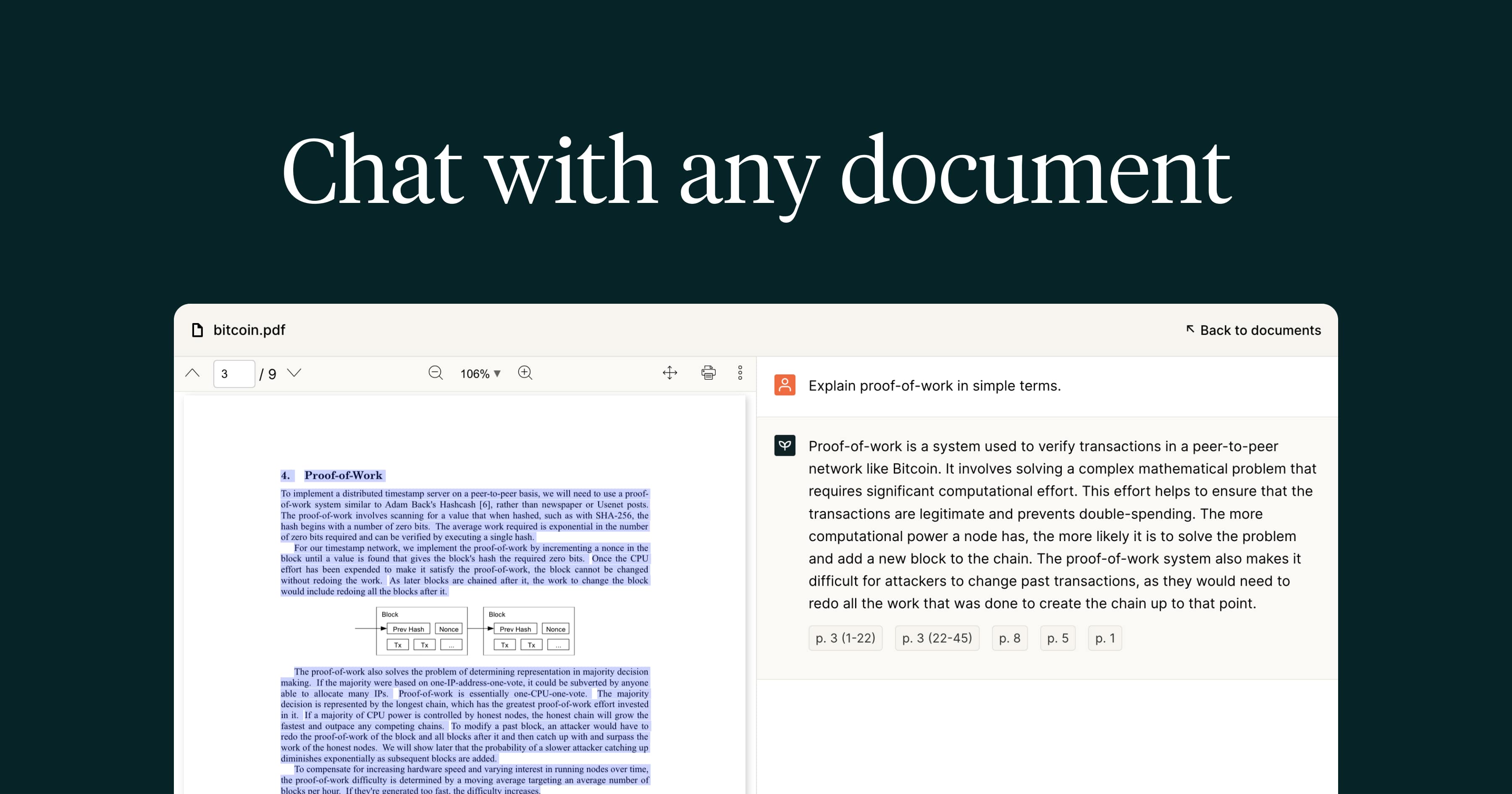
PDF.ai is an AI-powered tool that extracts and analyzes data from PDF documents, enabling users to streamline workflows, enhance data accessibility, and improve decision-making processes.
PDF.ai fundamentally transforms how professionals and students interact with PDF documents by enabling conversational analysis rather than static reading[5]. Users can upload PDFs and ask direct questions to extract insights, receive automatic summaries, and identify specific data points without manual searching or copy-pasting[1][2]. The platform leverages advanced artificial intelligence, natural language processing, and retrieval-augmented generation to understand context and semantic meaning, delivering accurate answers grounded directly in document content[1][3]. Key capabilities include intelligent search that understands context rather than just keyword matching, targeted data extraction for figures and dates, document organization through tagging systems, and smart redaction for sensitive information like personally identifiable data[1][2]. PDF.ai serves researchers, legal professionals, financial analysts, and enterprise teams, with specialized AI Document Agents for industry-specific applications and developer-friendly APIs for custom integrations[5][7]. What distinguishes PDF.ai is its intuitive chat interface that makes complex document analysis accessible to users of all technical levels, combined with its ability to process entire documents while maintaining accuracy, significantly boosting productivity and streamlining workflows for anyone regularly working with detailed PDF content[3][5].
The Privacy Policy does not explicitly address whether user data or uploaded documents are used to train AI models. The
The Privacy Policy does not explicitly address whether user data or uploaded documents are used to train AI models. The
Moderate risk. Suitable for internal data but avoid confidential information.
The Privacy Policy does not explicitly address whether user data or uploaded documents are used to train AI models. The vague language about using information 'to improve the content and functionality' could encompass model training, but no clear opt-out or explicit prohibition is stated.
“[Privacy] 'We use your personal information to respond to your inquiries, to provide you with information about our products and services, and to improve the content and functionality of our website.'”
The documents do not explicitly define the scope of license granted by users over uploaded content or generated outputs. The absence of clear licensing terms creates ambiguity about whether the vendor retains rights to user-submitted documents or AI-generated content.
“Not found in documents”
The Privacy Policy states data is not sold or shared except 'as required by law or as necessary to fulfill your requests,' which provides some protection. However, the policy lacks detail on sub-processors, service providers, or affiliate sharing arrangements, and does not mention a Data Processing Agreement.
“[Privacy] 'We do not sell or share your personal information with third parties except as required by law or as necessary to fulfill your requests.'”
The Privacy Policy does not specify data retention periods, deletion timelines, or automatic purge policies. No mention of how long uploaded documents are retained or what happens to data upon account termination.
“Not found in documents”
The documents do not address ownership of AI-generated outputs or user-submitted content. The absence of explicit IP ownership terms creates moderate uncertainty about whether the company claims rights to generated materials.
“Not found in documents”
The Privacy Policy mentions only 'reasonable measures' for security but provides no evidence of SOC 2, ISO 27001, GDPR compliance, HIPAA, or other formal certifications. No security documentation, trust page, or Data Processing Agreement is referenced.
“[Privacy] 'We take reasonable measures to protect your personal information from unauthorized access, disclosure, or use.'”
Track and measure your AI tools with Olakai's observability platform.
Explore Olakai