Motion
Analyze Motion is a tool that tracks and analyzes movement data, helping companies optimize performance, enhance safety, and improve operational efficiency across various industries.
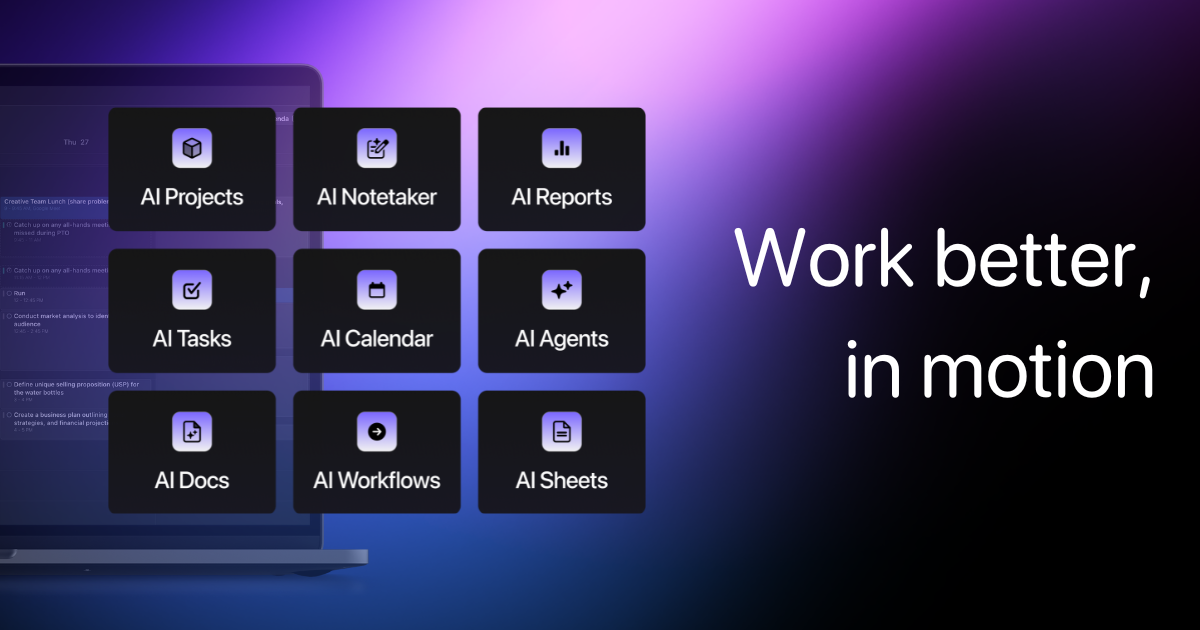
Motion is an AI-powered work management platform that helps individuals and teams organize their time, tasks, projects, meetings, and documentation in a single integrated workspace[4][8]. The platform uses artificial intelligence to automatically create and prioritize tasks, generate projects, manage schedules, and handle administrative work like note-taking and meeting summaries, with reported accuracy exceeding 90% out of the box[4][5]. Key capabilities include an AI Task Planner that automatically creates and prioritizes work, an AI Calendar Assistant that schedules meetings and plans days optimally, an AI Project Manager that generates projects in seconds, and an AI Docs Assistant that drafts and proofreads content[4]. Motion is designed for professionals ranging from individual freelancers and consultants managing multiple client projects to teams with heavy meeting schedules, offering particular value for those seeking to protect billable time and eliminate manual scheduling coordination[5][8]. The platform distinguishes itself through its ability to continuously adapt and auto-update plans as priorities and deadlines change, reducing the need for time-consuming resync meetings and enabling seamless communication within the context of specific projects and tasks[4]. Motion integrates with existing calendars, email, and other tools, allowing users to create customizable "AI Employees" such as executive assistants or project managers tailored to their specific workflow needs[8].
Privacy Policy mentions using data for 'training and developing machine learning algorithms' but lacks explicit detail o
Privacy Policy mentions using data for 'training and developing machine learning algorithms' but lacks explicit detail o
High risk across multiple dimensions. Only use with public, non-sensitive data.
Privacy Policy mentions using data for 'training and developing machine learning algorithms' but lacks explicit detail on whether user content trains Motion's AI models or opt-out mechanisms. The language is vague about scope and applicability to free vs. paid tiers.
“[Privacy] 'Training and developing machine learning algorithms, and identification of industry trends and developments, and anonymous benchmarking'”
ToS grants Motion a perpetual, irrevocable, worldwide, sublicensable license to user content for any purpose including derivative works, marketing, and redistribution. This is an extremely broad license that survives account termination.
“[ToS] 'royalty-free, transferable, perpetual, irrevocable, non-exclusive, and worldwide license, with the right to grant and authorize sublicenses, to use, reproduce, modify, publish...for use in connection with the Service and Motion's...business, including...for promoting and redistributing'”
Privacy Policy shares data with service providers, affiliates, and payment processors under DPAs, but language around 'affiliates' and 'other companies under common ownership' is broad. Subprocessor list exists but sharing scope with marketing/analytics partners is somewhat vague.
“[Privacy] 'We may share personal information with other companies and brands owned or controlled by Nexusbird, Inc.' and [DPA] 'Motion maintains an up to date list of its Subprocessors located at http://www.usemotion.com/legal/subprocessors'”
Privacy Policy states retention 'for the duration of your account and for up to one year after an account is deleted' with permanent deletion after that, but ToS Section 1.5 allows Motion to terminate accounts 'with or without notice and without liability, for any reason.' Backup retention details are limited to 90 days post-deletion request in DPA.
“[Privacy] 'We retain personal information for the duration of your account and for up to one year after an account is deleted' and [DPA] 'delete any Customer Data on Motion's backup system within ninety (90) days after Customer's request'”
ToS Section 3 explicitly states Motion claims no ownership of user content but grants itself a perpetual, irrevocable, sublicensable license to use, modify, and create derivative works. This effectively gives Motion broad IP rights over outputs despite nominal user ownership.
“[ToS] 'We claim no ownership rights over your User Content...However, you...grant...to Motion a royalty-free, transferable, perpetual, irrevocable, non-exclusive, and worldwide license, with the right to grant and authorize sublicenses, to use, reproduce, modify, publish...make derivative works'”
Privacy Policy mentions SOC 2 Type II audit completion and Google Cloud Platform certifications, but does not explicitly list ISO 27001, HIPAA, or formal GDPR compliance certification. DPA references GDPR, CCPA, and other regulations but compliance is contractual rather than certified.
“[Privacy] 'Motion successfully completed the SOC 2 Type II Audit by Prescient Assurance' and [DPA] 'Applicable Data Protection Laws' means GDPR, UK GDPR, Swiss DPA, PIPEDA, CCPA, and LGPD”
Track and measure your AI tools with Olakai's observability platform.
Explore Olakai