Lokalise AI
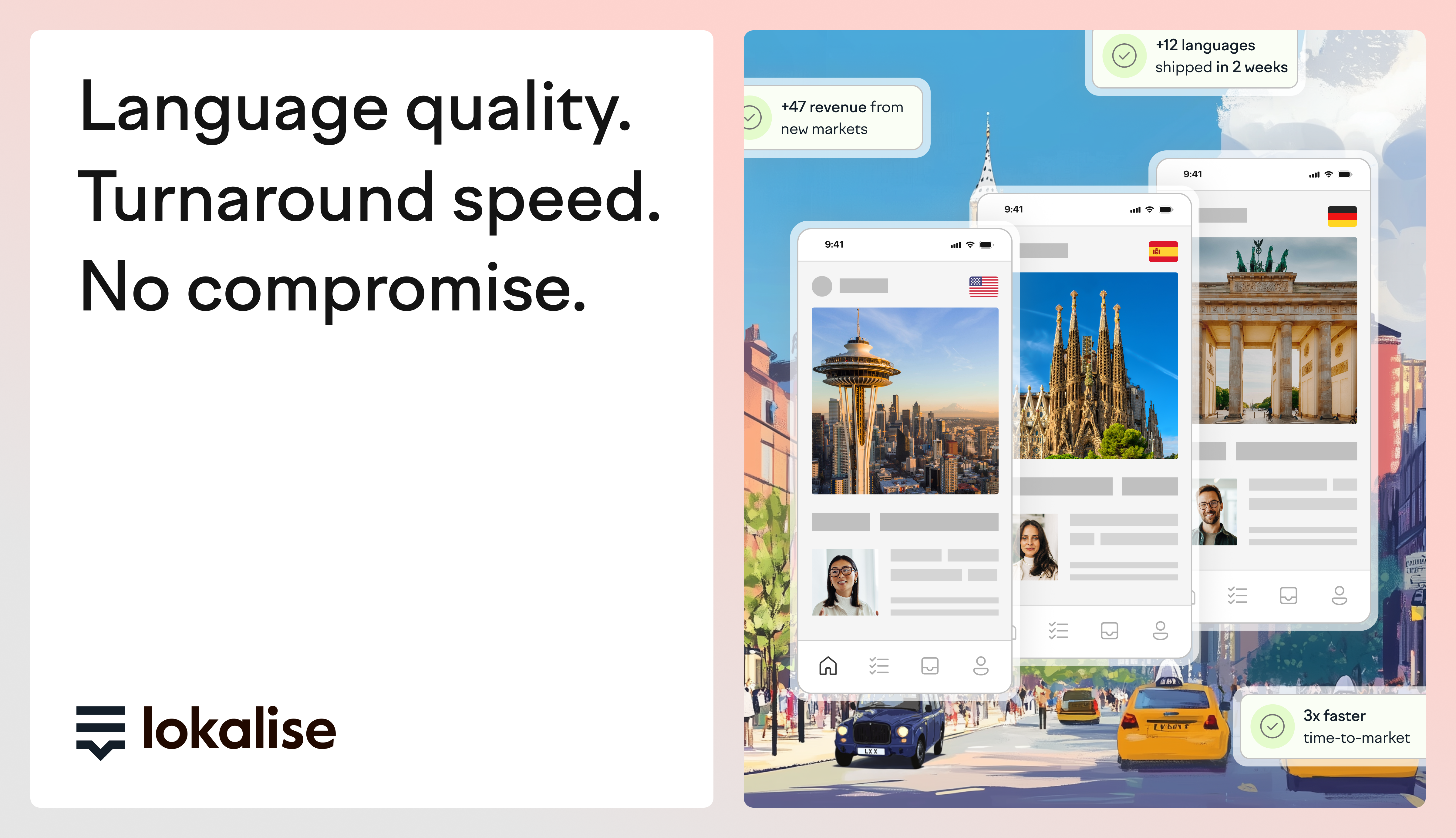
Lokalise AI streamlines the translation and localization process for software and applications, enabling teams to manage multilingual content efficiently and enhance global reach.
Lokalise AI is a cutting-edge translation assistant integrated into the Lokalise continuous localization platform, delivering human-quality translations at unprecedented speed and scale to streamline multilingual content management for software, websites, apps, campaigns, and customer support.[1][2][4] Its core value proposition lies in automating the most time-consuming aspects of localization, reducing costs by up to 80% and accelerating processes up to 10 times faster while preserving brand voice, terminology, and cultural nuances through context-aware AI orchestration.[1][9]
Key features include smart routing across advanced models like GPT-5 and Claude, automatic enrichment with glossaries, style guides, and translation memory, one-click optimizations for SEO or design constraints, and built-in QA reports with pass/fail scores to highlight critical issues.[1][2][8] It targets development teams, marketers, and localization managers at companies of all sizes seeking efficient global expansion, with seamless integrations into over 50 tools and workflows for agile, end-to-end localization.[1][5][7]
What sets Lokalise AI apart is its achievement of human-parity translation quality—ready to publish in 80% of cases without edits—bridging machine and human efforts through analytics that compare AI and manual outputs, custom profiles, and design-stage automation, positioning it as a market leader revolutionizing the industry.[1][2][3][4]
Sources
- [1] https://slator.com/a-new-era-of-localization-begins-with-lokalise-ai/
- [2] https://docs.lokalise.com/en/articles/8011393-ai-translations
- [3] https://www.youtube.com/watch?v=qS8kEiL9TEM
- [4] https://lokalise.com/ai/
- [5] http://oreateai.com/blog/unlocking-global-potential-how-lokalise-ai-translation-transforms-localization/b855c9b0e899b05effe9fdf03592fe27
- [7] https://lokalise.com
- [8] https://docs.lokalise.com/en/collections/17223450-ai-features
- [9] https://lokalise.com/blog/how-ai-translation-works/
Lokalise references AI Features governed by an Annex C (AI Addendum) but the addendum text is not provided in the docume
No training opt-out mechanism was identified in the legal documents.
Moderate risk. Suitable for internal data but avoid confidential information.
Lokalise references AI Features governed by an Annex C (AI Addendum) but the addendum text is not provided in the documents. The Privacy Policy mentions using data for 'service improvement' and creating 'new features' but lacks explicit clarity on whether user content trains AI models. The vague language and missing AI Addendum create moderate concern.
“[ToS] 'Your access to and use of any artificial intelligence or machine learning functionalities made available within the Services ("AI Features") is governed by Annex C (the "AI Addendum")' — but Annex C not provided in documents.”
The ToS grants Lokalise a 'non-exclusive license to host, store, process, and display User Content for the purpose of providing the Services' with deletion upon termination. However, the license scope is somewhat broad ('process and display') and the Privacy Policy indicates data may be used for service improvement and feature creation, creating ambiguity about sublicensing and derivative use rights.
“[ToS] 'You grant Lokalise a non-exclusive license to host, store, process, and display User Content for the purpose of providing the Services. Lokalise may delete User Content upon the expiration or termination of your access.'”
Lokalise shares data with 'trusted entities,' 'third-party vendors,' 'corporate affiliates,' and integrations with third-party services. A sub-processor list is published and referenced, but the Privacy Policy states data may be shared with 'partners' and 'affiliates' for 'internal administrative' purposes with somewhat vague controls. Aggregated/anonymized data sharing is permitted.
“[Privacy] 'We share your Personal Data with a limited number of third-party vendors and business partners who process it on our behalf... The updated list of our Sub-processors can be found here https://lokalise.com/sub-processors.'”
The Privacy Policy states data is retained 'no longer than necessary' and deleted 'in accordance with statutory provisions,' with retention periods of 6-10 years for tax/commercial obligations and 3 years for other data. However, the language is vague ('no longer than necessary') and data may be retained after account deactivation for 'legitimate business interests,' creating moderate uncertainty.
“[Privacy] 'We will process and store the User Data no longer than necessary... storage and documentation obligations from commercial and tax laws apply. The retention and documentation periods specified there are six to ten years.'”
The ToS explicitly states that for Authorized Users, User Content 'is and remains the sole property of the Customer' and for Trial Users, content is 'owned by you.' Lokalise claims only a non-exclusive license to provide the service, with no rights to outputs beyond service delivery. This is enterprise-friendly.
“[ToS] 'All data and content submitted by you in your use of the Services ("User Content") is and remains: For Authorized Users: the sole property of the Customer; For Trial Users: owned by you, subject to Lokalise's rights under Section 4.2.'”
The Privacy Policy explicitly states Lokalise 'has received internationally recognized SOC 2 Type 2 security certification' and confirms compliance with GDPR, EU-U.S. Data Privacy Framework, UK Extension, and Swiss-U.S. DPF. A DPA is available for download and a sub-processor list is published, meeting enterprise security standards.
“[Privacy] 'Lokalise has received internationally recognized SOC 2 Type 2 security certification confirming that Lokalise has system and organization controls to safeguard the processing, integrity, confidentiality and security of the User Data.'”
Track and measure your AI tools with Olakai's observability platform.
Explore Olakai